
Anti Inflammatory Foods: What the Evidence Actually Supports
Last updated: 31 July 2026 · Reviewed against primary sources by the Peremis Editorial Team
Most articles on anti inflammatory foods give you the same colourful list and move on. This one shows what the research actually found, including the parts that make the marketing look thin.
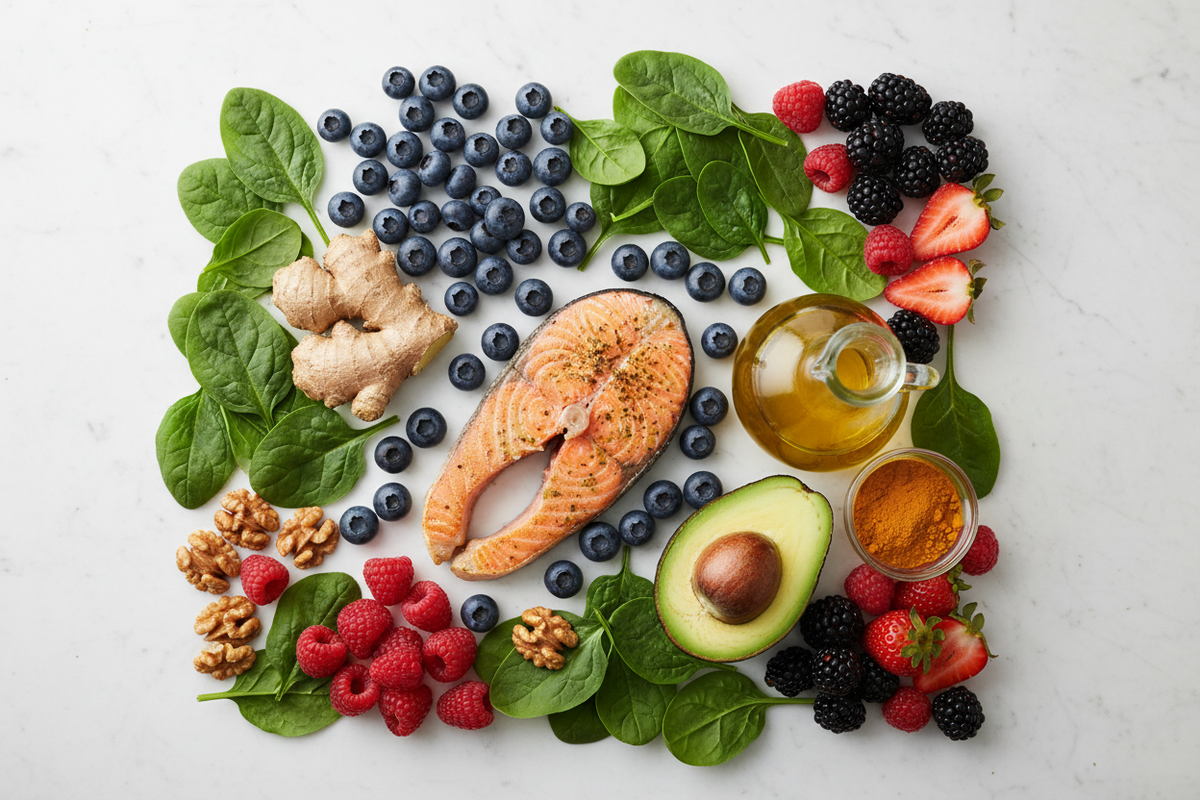
The best anti inflammatory foods are extra virgin olive oil, oily fish, beans and lentils, nuts and seeds, whole grains, leafy greens, berries and other deeply coloured produce, and spices such as turmeric and ginger. They work as a pattern, not as single heroes. The strongest human evidence points to a Mediterranean style way of eating overall, not to any one item on the list.
Key Takeaways
- The pattern beats the plate. The most pro inflammatory diets carry roughly a third higher cardiovascular risk than the most anti inflammatory ones.
- PREDIMED, the famous olive oil trial, was retracted in 2018 and republished after randomisation problems. The corrected result still showed a benefit.
- Omega 3 supplements move inflammatory markers more reliably than they move real outcomes. The largest prevention trial found no benefit on its main heart endpoint.
- Curcumin trials do show lower C reactive protein, but they are small, and absorption is poor without piperine or a fat based form.
- Cutting ultra processed food is probably the biggest lever most people have, and a controlled feeding trial supports it.
- Marker changes and how you feel are different things, and the honest timeframe is weeks to months.
What inflammation actually is, and what food can and cannot do
Inflammation is not the villain. It is how your immune system responds to injury and infection.
The concern is chronic low grade inflammation, the quiet hum measured by markers such as C reactive protein (CRP) and interleukin 6 (IL 6). Higher long term levels track with worse cardiovascular and metabolic outcomes.
Food does not treat, cure or prevent disease. It shifts the inputs, and the balance across a week matters far more than any single meal. Our guide to chronic inflammation causes and solutions covers sleep, stress and body composition too.
How researchers score a diet for inflammation
Researchers use the Dietary Inflammatory Index, published by Shivappa and colleagues in Public Health Nutrition in 2014. The team screened roughly 6,500 papers, scored 1,943, and rated 45 dietary components on whether they raise or lower six inflammatory markers.
The most anti inflammatory diet possible scores about minus 8.87. The most pro inflammatory scores about plus 7.98. Fibre, magnesium, vitamins C and E, beta carotene, omega 3 and monounsaturated fats, flavonoids, garlic, onion, pepper, ginger, turmeric and tea land on the anti inflammatory side. Saturated fat, trans fat, cholesterol and total energy land on the other.
What does a lower score buy you? A meta analysis of 12 datasets covering 161,337 people found the most pro inflammatory diets carried 36 percent higher cardiovascular risk than the most anti inflammatory ones (RR 1.36, 95 percent CI 1.19 to 1.57), with about 8 percent higher risk per point.
These are observational associations, so they cannot prove cause. But the size and consistency are hard to ignore.
Eat more, limit these
| Category | Eat more of these | Limit these |
|---|---|---|
| Fats | Extra virgin olive oil, avocado, nuts, seeds | Deep fried foods, hydrogenated spreads |
| Protein | Salmon, sardines, mackerel, beans, lentils, tofu | Processed and cured meats |
| Carbohydrates | Oats, barley, quinoa, brown rice, sweet potato | White bread, pastries, sweetened cereal |
| Produce | Berries, cherries, leafy greens, cruciferous veg, tomatoes | Fruit juice and fruit flavoured snacks |
| Drinks | Water, green tea, black tea, plain coffee | Soft drinks, energy drinks, sweetened coffee |
| Flavour | Turmeric, ginger, garlic, onion, black pepper, herbs | Packaged sauces high in sugar and refined oil |
The strongest evidence, told honestly: PREDIMED
PREDIMED is the trial everyone cites. Roughly 7,447 Spanish adults at high cardiovascular risk were assigned to a Mediterranean diet with extra virgin olive oil, the same diet with mixed nuts, or a low fat control diet, for a median of about five years.
Here is the part most articles skip. The original 2013 paper was retracted in 2018. Some household members had been put in the same group without randomisation, one site randomised whole clinics rather than individuals, and another used its tables inconsistently.
The authors reanalysed, excluded 1,588 participants whose allocation could not be verified, adjusted for clustering, and republished. As Harvard's Nutrition Source summarised, the corrected result still showed roughly 30 percent fewer major cardiovascular events in both Mediterranean groups.
So the headline survived. But the trial can no longer claim clean randomisation, which makes it weaker evidence than it was sold as.
The marker evidence keeps building. A 2025 meta analysis in Nutrition Reviews pooled 33 trials in 3,476 people and found the Mediterranean pattern significantly lowered high sensitivity CRP, IL 6 and IL 17, but not TNF alpha.
What each famous food is actually carrying
| Food | Key compound | What the human evidence shows | Evidence strength |
|---|---|---|---|
| Extra virgin olive oil | Oleocanthal, oleic acid, polyphenols | Central to PREDIMED and Mediterranean marker trials | Strong for the pattern, modest for the compound |
| Oily fish | EPA and DHA | Lowers CRP and IL 6 in pooled trials, outcomes mixed | Good for markers, inconsistent for outcomes |
| Beans, lentils, whole grains | Fermentable fibre | Observational data consistent, trial data mixed | Moderate |
| Berries and dark produce | Anthocyanins, flavonols | Score anti inflammatory in the Dietary Inflammatory Index | Moderate |
| Turmeric | Curcuminoids | Lowers CRP in pooled trials, but trials are small | Promising, not settled |
| Coffee and tea | Chlorogenic acid, catechins | Pooled coffee data show no significant CRP effect | Genuinely mixed |
Omega 3: the marker story and the outcome story
Fish oil reliably lowers inflammatory markers in pooled trial data. That part is not controversial. What happens next is. VITAL, one of the largest prevention trials ever run, gave 25,871 adults either 840 mg a day of marine EPA and DHA or placebo for a median of 5.3 years. For the main endpoint of heart attack, stroke or cardiovascular death, the result was null: hazard ratio 0.92, 95 percent CI 0.80 to 1.06. A secondary analysis showed lower heart attack risk, but secondary endpoints generate hypotheses, they do not prove them.
Moving a marker and changing an outcome are different achievements. Peremis does not sell fish oil or omega 3, so we have no reason to spin this. Eat the fish twice a week and treat capsules as a separate conversation with your doctor.
Turmeric and curcumin: what the trials really show
We sell a turmeric product, so this section needs to be the most careful one in the article.
Pooled data do show an effect. A 2022 meta analysis in Phytotherapy Research found curcumin lowered CRP by a weighted mean difference of 3.67 mg/L (95 percent CI minus 6.96 to minus 0.38), catalogued in the UWA repository. An earlier one assessed by the NIHR DARE database pooled six trials, 172 people on curcuminoids and 170 on placebo.
Now the caveats. Six trials and 342 people is a small evidence base. Many curcumin trials are funded by ingredient manufacturers. Confidence intervals are wide. And that earlier analysis found the effect held only in trials using bioavailability improved preparations lasting at least four weeks.
That last point is the whole ballgame. Plain curcumin is barely absorbed. In the classic Shoba 1998 study in Planta Medica, volunteers given 2 g of curcumin alone had serum levels that were undetectable or very low. Adding 20 mg of piperine from black pepper raised relative bioavailability about 2,000 percent.
Take turmeric without piperine or a lipid based delivery and you may absorb very little. We cover the mechanics in turmeric and BioPerine absorption and the label terms in curcumin versus turmeric extract.
Food first wins here. Turmeric in cooking, with fat and black pepper, is cheap and low risk. A supplement is a top up, not a replacement.
Olive oil and oleocanthal, in context
You have seen the claim that olive oil works like ibuprofen. It comes from a real paper: Beauchamp and colleagues in Nature in 2005, which identified oleocanthal as the compound behind the peppery sting in fresh extra virgin olive oil and showed it inhibits COX 1 and COX 2 dose dependently, much like ibuprofen.
Here is the number the headlines leave out. The authors calculated that 50 g of olive oil a day, roughly three and a half tablespoons, delivers up to about 9 mg of oleocanthal. That is around 10 percent of a typical adult ibuprofen dose.
Ten percent, spread across a day, from a food. An interesting signal about long term exposure. Not a painkiller in a bottle.
Ultra processed food is probably your biggest lever
In a controlled NIH inpatient study, 20 adults lived on a metabolic ward for a month, eating an ultra processed or a minimally processed diet for two weeks each in random order. The diets were matched for calories offered, sugar, fat, fibre and carbohydrate. People ate as much as they wanted.
On the ultra processed diet they ate about 500 extra calories a day and gained 0.9 kg. On the minimally processed diet they lost about the same. Same nutrients on paper, opposite results.
The cohort data line up. In 2,018 Australian adults, every 100 g increase in ultra processed food intake was linked to 4.0 percent higher high sensitivity CRP (95 percent CI 2.1 to 5.9). Adjusted for BMI it held at 2.5 percent, so part of the effect is not simply body weight.
It also spikes blood glucose harder. If that is your sticking point, start with blood sugar spikes after meals.
Fibre, your gut and short chain fatty acids
The story goes like this. You eat fermentable fibre, gut bacteria turn it into short chain fatty acids such as butyrate, and butyrate supports the gut lining and calms immune signalling. The mechanism is real. The human trial data are messier.
A review of 44 studies in healthy adults found fibre supplements did not consistently raise short chain fatty acids, with effects dependent on dose and fibre type. In the TRIM trial, 162 overweight adults took 7 g or 14 g of psyllium daily for three months and CRP did not drop significantly.
Whole grains show the same split. A Nutrition Reviews summary notes several six week trials in healthy adults found no change in CRP or IL 6, while studies in people with metabolic problems did find reductions.
The practical read: whole food fibre is worth eating, but do not expect a fibre powder to do the same job. More in our gut microbiome practical guide and supplements for gut health.
Coffee: genuinely undecided
Coffee is loaded with chlorogenic acids and is usually called anti inflammatory. The pooled evidence does not support that.
A 2020 meta analysis in Nutrients combined 11 studies covering 61,047 people and found no significant overall association between coffee intake and CRP (mean change minus 2.4 percent, 95 percent CI minus 8.7 to plus 4.4). Three large studies did find lower CRP in European and US women and Japanese men, while European men showed a 2.2 percent increase.
Drink it if you enjoy it and it does not wreck your sleep. Just do not drink it as an anti inflammatory strategy, and do not turn it into a dessert.
What the evidence supports, and what gets oversold
| Common claim | What the evidence actually supports | Verdict |
|---|---|---|
| "This food fights inflammation" | Diet patterns move markers. Single foods are rarely tested alone | Oversold |
| "Olive oil is like ibuprofen" | 50 g a day gives about 9 mg oleocanthal, near 10 percent of an ibuprofen dose | True but heavily exaggerated |
| "Fish oil protects your heart" | VITAL found no benefit on its primary endpoint | Overstated for prevention |
| "Turmeric is a proven anti inflammatory" | CRP falls in pooled trials, but samples are small | Promising, not proven |
| "Fibre supplements lower inflammation" | A three month psyllium trial found no CRP change | Not supported |
| "Cut ultra processed food" | A controlled feeding trial and cohort CRP data agree | Well supported |
A one week swap plan
One change per day. Keep whatever sticks.
| Day | The swap | Why it works |
|---|---|---|
| Monday | Cook with extra virgin olive oil instead of refined oil | The fat behind the Mediterranean trial results |
| Tuesday | Swap one packaged snack for nuts and fruit | Cuts ultra processed intake, the biggest lever |
| Wednesday | Add a tin of sardines or salmon to lunch | Whole food EPA and DHA, no capsule |
| Thursday | Add half a tin of beans or lentils to whatever you are making | Fermentable fibre plus plant protein |
| Friday | Swap one sweetened drink for water, tea or plain coffee | Removes liquid sugar, keeps the ritual |
| Saturday | Cook one meal with turmeric, black pepper and olive oil | Piperine plus fat is how curcumin is absorbed |
| Sunday | Build two plates that are half vegetables, two colours minimum | The pattern in its simplest form |
How long before you feel anything
Marker changes in trials usually take four to twelve weeks. Symptom changes are far less predictable, because CRP is not a feelings meter.
Some of what people notice in the first fortnight is not inflammation at all. It is steadier blood sugar, more fibre and less alcohol. Still a win, just a different mechanism.
Does inflammation matter causally? Probably yes. In CANTOS, an injectable drug that cut high sensitivity CRP by about 37 percent more than placebo lowered cardiovascular events in 10,061 heart attack survivors without changing cholesterol. It also raised fatal infections. Food is not that drug, but the target is real.
Where supplements honestly fit
Last, because that is where they belong. Nothing in a capsule outperforms eating this way consistently. Supplements are a top up, not a shortcut past a poor diet.
If you do want one, three rules. Choose forms where absorption is addressed, such as curcumin with piperine. Check the dose against what trials used, using our guide to reading a supplement label. Give it eight weeks.
Our turmeric curcumin with BioPerine exists for that narrow job. If joints are your concern, read best turmeric for joints and supplements for joint pain first. For the wider category, including options we do not sell, see anti inflammatory supplements.
Frequently asked questions
What are the best anti inflammatory foods to start with?
Start with extra virgin olive oil, oily fish twice a week, beans or lentils, nuts, leafy greens and berries. These sit on the anti inflammatory side of the Dietary Inflammatory Index and form the backbone of Mediterranean style eating, which has the strongest trial evidence for lowering CRP.
What foods cause the most inflammation?
The most pro inflammatory components in the Dietary Inflammatory Index are saturated fat, trans fat, cholesterol and excess total energy. In practice that means fried food, pastries, sweetened drinks and processed snacks. Ultra processed food matters most, since a controlled NIH trial showed it drove about 500 extra calories daily.
How long does it take for anti inflammatory foods to work?
Trials measuring inflammatory markers usually ran four to twelve weeks before seeing changes. How you feel is less predictable and does not track markers closely. Early improvements in energy or bloating within two weeks often reflect steadier blood sugar and more fibre rather than inflammation itself.
Is turmeric as effective as the internet claims?
Pooled trials do show curcumin lowers C reactive protein, but the evidence base is small, confidence intervals are wide, and many studies are industry funded. The effect held mainly in trials using absorption enhanced preparations lasting at least four weeks. Turmeric is worth cooking with, not a replacement for eating well.
Do I need fish oil, or is eating fish enough?
For most people food comes first. The VITAL trial gave 25,871 adults 840 mg of EPA and DHA daily and found no benefit on its primary cardiovascular endpoint. Omega 3 does lower inflammatory markers, but markers and outcomes differ. Peremis does not sell fish oil, so ask your doctor.
Is coffee inflammatory or anti inflammatory?
The honest answer is that it is unclear. A meta analysis of 11 studies in 61,047 people found no significant overall association between coffee intake and CRP. Some subgroups showed small decreases and one showed a small increase. Drink it if you enjoy it, and skip the sugar.
Can anti inflammatory foods help with joint comfort?
Many people report easier movement when they eat this way, and the pattern supports general wellness. Food does not rebuild cartilage and no diet treats joint disease. Treat it as one input alongside strength work and sleep, and speak to a clinician about persistent joint pain.
Do I need a supplement if I already eat well?
Probably not for inflammation specifically. No supplement outperforms a consistent Mediterranean style pattern, and fibre supplements failed to lower CRP in a three month randomised trial. If you do add one, choose an absorbable form, match the dose to what trials used, and give it eight weeks.
Pick one swap from the plan and run it for a week. If you want a well absorbed turmeric alongside the food work, our turmeric curcumin with BioPerine pairs curcuminoids with black pepper extract for the reason described above. If digestion or steady energy is your sticking point, look at Colon Care, Blood Sugar Defense or our mushroom blend. Food first. Supplements second.
About this guide. Written by the Peremis Editorial Team. Every study referenced here was read at source and linked to the journal, institution or trial record rather than a summary. Where evidence is weak, mixed or unflattering to products we sell, we say so. We do not cite studies we have not read.
This article is educational and is not medical advice. These statements have not been evaluated by the Food and Drug Administration. These products are not intended to diagnose, treat, cure, or prevent any disease. Speak with your doctor before changing your diet or starting a supplement, especially if you take medication or have a health condition.